Service, Repair and Maintenance

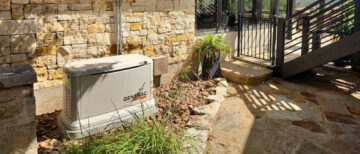
As home backup generators become more ubiquitous, so has the need for service, repair and maintenance. Modern generators are
built to higher standards than ever, however, they are still internal combustion engines that consume vaporous gas to turn
magnetized rotors inside wound stators to deliver electricity within precise specifications to a home with sensitive electronics.
Sounds complicated, right? Well, to a trained and seasoned generator technician, it’s just another day at the job.

Despite the improved production and QA standards, just like your car, HVAC system or septic system, these machines require
periodic inspection, maintenance, and sometimes, repairs. Like anything, catching issues early is the key to ensuring long life and
maximum functionality. Furthermore, virtually every manufactured system has its own “gremlins”. An experienced technician,
working for a reputable company that keeps up with training and service publications, can work these issues out of a generator to
ensure maximum reliability. After all, an emergency power system that fails in an emergency is unfortunate irony.

Service agreements are an excellent way to keep your generator functioning as well as possible with regular inspections of the most
common failure points as well as engine maintenance, valve train maintenance, battery health, oil leak checks, etc. Services should
be performed twice a year, usually before the summer and winter seasons. In the spring, checking for insect infestations, oil leaks,
battery terminals, and a clear record of regular starts over the winter months is important. In the fall, checking fuel levels, gas
pressure, vegetation overgrowth, and possibly load-banking units to ensure the unit can generate the amount of power that it is
rated to produce is important. Winter loads for electrically heated homes are generally higher than summer loads.

In addition to purchasing a service agreement for your generator, Generac customers can purchase extended warranties for up to 10
years. These warranties indemnify the homeowner of repair costs and includes labor and parts. Generac pays certified technicians
to diagnose, procure parts and make necessary repairs for units under warranty. Companies that employ Generac certified
technicians stock most parts for common units, such as air-cooled Guardian series units, making repairs expeditious and efficient.

Consider the difference between the following: being informed by your technician that your generator experienced an issue, was
repaired and tested with no charge – or – experiencing an outage only to find out that your generator failed to start when you really
needed it.

Whole-House Generators

Whole house generators have become popular home improvements in recent years. Multiple
winter storms have crippled the state’s grid, political unrest has become a real concern for
many, and the flow of millions of newly minted Texans has only exacerbated the need for
power.


As with any electro-mechanical system, a whole-house generator requires a bit of maintenance.
For generator owners, ensuring their power stays on when the power turns off doesn’t need to
be a source of worry or surprise by big invoices and hassles.


Generators do require regularly scheduled maintenance. Manufacturers build alerts into their
systems to make sure that system owners are aware of this. For example, Generac units throw
an alarm code annually to check the battery. Batteries are the number one failure in
generators – and it’s usually a hidden failure. Because batteries are out in the elements, they
are highly susceptible to corrosion. While this is an easy problem to repair and prevent, it’s
nefarious because the battery will still provide voltage to the controller, will still charge, and
will still present itself as viable UNTIL large amounts of amperage are demanded of it – to start
the generator!


This example is one of many, illustrating how something easy to remediate and prevent can
become a total failure at the most essential moment. Other examples include firmware
updates, sensor circuit grounding, engine break-in service, inlet gas pressure adjustment
(they’re almost always too low), and oil consumption (break-in periods burn oil).


To a seasoned generator technician, these are all easy to spot, easy to fix, and easy to prevent.
However, that assumes that a technician is looking at the generator. Maintenance contracts
are an easy way to ensure that a professional is looking after your system.


Another maintenance “low hanging fruit” for generator owners is to take time to learn how the
transfer switch and generator work and work together. That doesn’t mean memorizing
complicated wire diagrams, it just means learning the basic function from an experienced
technician to learn the steps to get lights back on quickly and easily.


For example, Generac Auto Transfer Switches are manufactured with a provision to manually
transfer in the case that the auto function failed. Generators can be manually started in the
case the that the auto start failed. Overloaded generators can be reset in a matter of seconds.
Generators are insurance policies, make sure the policy is in good standing.

Solar and Generators

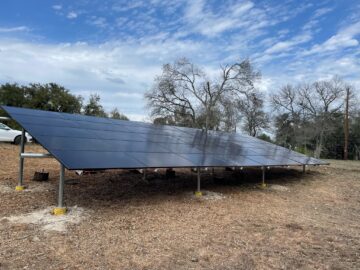
During normal conditions, a grid-tied solar PV system “pushes” electricity into the
home’s electrical service to be used by electrical loads. Excess energy goes through
the meter to the electrical utility. During grid outages, a home backup generator starts
itself and “tells” the transfer switch goes into action. The transfer switch isolates the
generator from the grid, protecting linemen and not causing electrical interference on
the grid.


Utilizing both systems, the home is saving money during normal operation and powered
up during electrical outages. However, there are some issues that need to be
addressed for this setup to work safely and correctly.


Grid-tied PV systems are basically current pumps. They sense the grid’s electrical
parameters and dutifully push electricity into the circuit. The word “push” is used
because in a sense, that’s exactly what it’s doing – it’s generating electricity with more
electromotive force than the grid’s supply. Wait, what?


Imagine a water pipe supplying a house with 40 psi. Say the house wanted to send
water BACK to the supply. It would have to generate MORE pressure to send the water
back against a 40-psi supply. So, it might generate 45 psi so that the water flows
backwards.


This fundamental concept applies to any electrical system that has both a generator and
a PV system. A PV system cannot distinguish between a grid or a generator. During a
power outage, the PV system will attempt to back feed a connected generator, thinking
that it’s the grid. This can cause damage to the generator and possibly fires or electrical
hazards. Careful consideration must be taken to isolate the solar system from the
generator.


There are two ways to accomplish this: One method is to connect the PV output circuit
to the utility side of the generator’s transfer switch. This ensures that when the grid
electricity is not available, the PV system doesn’t have a place to export, and shuts off.
The other method is to install a contactor on the PV output circuit. Basically, the
contactor (a large switch) shuts off the connection to the PV system when the
generator is running. Generac Smart Management Modules can be configured to
perform this task on Generac units.


These two simple isolation techniques can ensure that your two electrical generation
devices don’t cause thousands of dollars in damage to each other, the home, or its
occupants.

PEC RATES

On March 1 st , 2022, Pedernales Electric Coop announced a change to its Solar Interconnection
Rate. The change was made after results of a board-commissioned study were published in
November 2021. The stated mission of A Review of the Value of Solar Study, performed by GDS
Associates and corroborated by the Perryman group, for Pedernales Electric Cooperative was to
“true up” the previous solar interconnection rate; to account for a “subsidy” that PEC claimed
solar owners were receiving at the expense of non-solar owners.

This subsidy is described in the report as follows: “The “Value of Solar Study” shows that a
member-owned solar system provides some decrease in costs for transmission access charges
during the summer, but solar systems do not reduce the direct costs incurred by PEC for
investment, operations, and maintenance of the distribution system.”

“With increasing use of distributed generation among customers, electricity providers must
determine the appropriate method and amount of compensation to provide these customers. The
compensation must be fair and equitable to all customers. In addition, it must cover associated
costs to make the programs economically feasible and sustainable.” – Perryman Group
Meters at solar-equipped services record Delivered power, Received power, and Net usage.
Previously, PEC billed solar owners for the Net kilowatt hour value. Bear in mind that a solar
system’s electrical production services the home first, with excess power traveling “up” the
meter and onto PEC’s lines. Essentially, PEC was buying each kilowatt hour received from the
member at the delivery rate.

“From a rate standpoint, the reduced energy purchases of a member with [Distributed
Generation] will be treated the same for equity purposes as if a homeowner installed energy
efficiency measures to reduce energy consumption.” -Value of Solar Study, 2021
A kilowatt sent back to PEC’s lines is credited on the member’s bill at a rate of $.055377 per
kilowatt hour. Essentially, members will pay for every kilowatt delivered at the normal rate, but
see a line-item credit on their bill for about 5.5 cents per kilowatt hour sent to PEC’s electrical
infrastructure.

For members considering going solar, this will affect their ability to accurately calculate
financial payback models, as a produced kilowatt hour may be worth about 5.5 cents or about
twice that if consumed. One strategy might be to orient arrays westward, to closely match power
demand curves. Calculating solar production is easy, matching consumption in real time can be
challenging.

Value of Solar Study: https://www.pec.coop/wp-content/uploads/2021/11/Interconnected-
Generation-Value-of-Solar-Study-Report.pdf
Perryman Group Review https://www.pec.coop/wp-content/uploads/2021/11/Interconnected-
Generation-Perryman-Group-VOSS-Review.pdf
PEC Interconnection Rates https://www.pec.coop/your-service/distributed-
generation/interconnection-rates/

  • 1
  • 2